
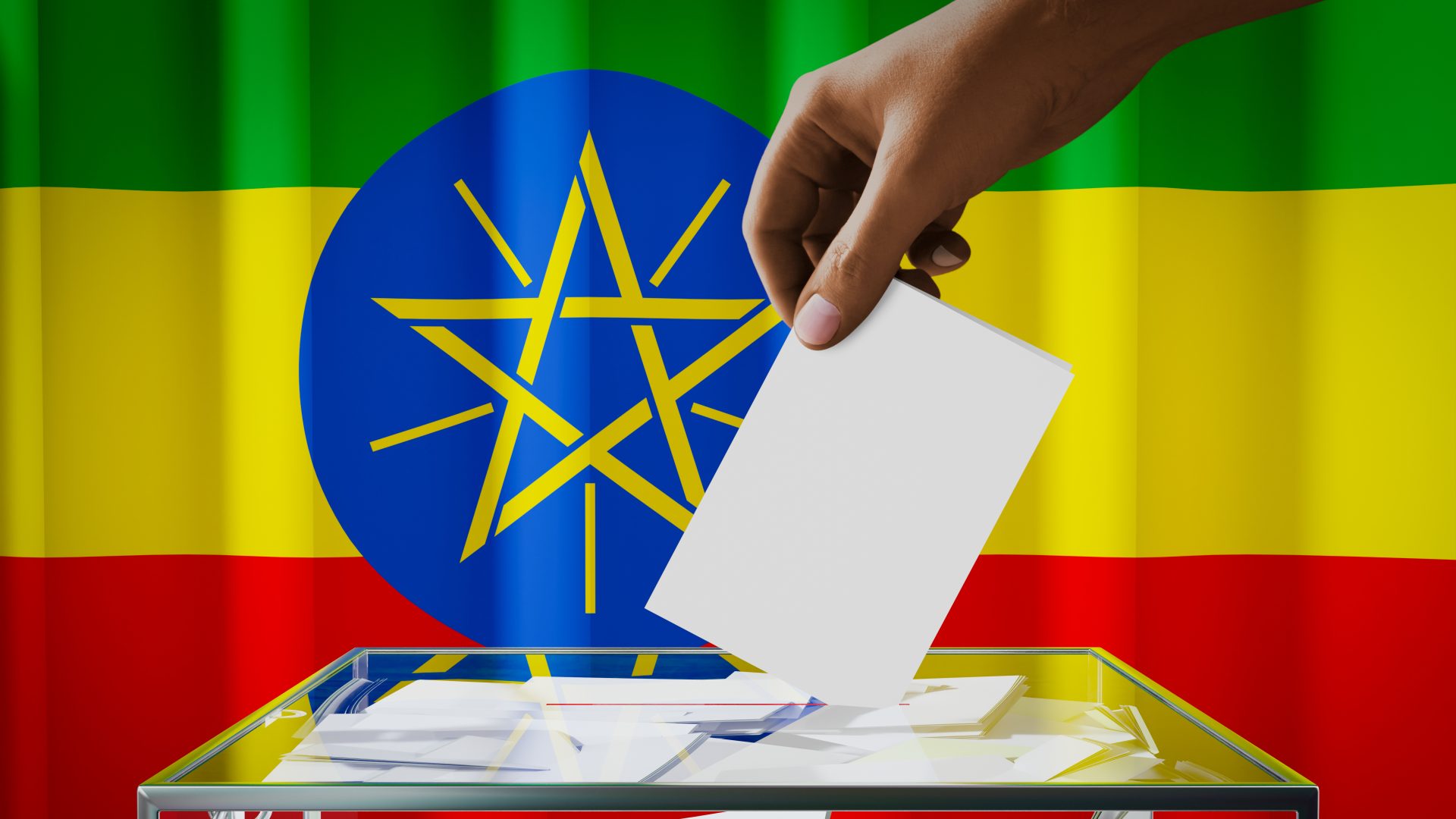
Ethiopia’s seventh general election is scheduled for 1 June 2026. On the surface, the procedural gears appear to be turning. The National Election Board of Ethiopia (NEBE) continues to follow its electoral calendar with repeated assurances of technical rigour that, at least formally, promises to be stronger than the previous cycles.
As of April 2026, more than 50 million voters, described by officials as ‘a historic high,’ had reportedly been registered. Twenty-four national parties and forty-five regional parties are set to contest, although twelve political parties have been disqualified for non-compliance. Over 195,000 election personnel have been deployed, live televised political debates and consultations between NEBE and political parties have been held, and 169 civil society organisations have been registered to do election-related work. A new feature of this electoral cycle is the digitalisation of the process, introduced by NEBE as an efficiency and modernisation measure, with funding committed from domestic sources and international partners.
Yet beneath these procedural preparations lies a political and security landscape that remains deeply complex and unpredictably fluid. In everyday conversations, the prospect of a credible election is increasingly reduced to what many colloquially describe in Amharic as qintot, a luxury distant from the realities shaping daily life. For citizens struggling with ongoing conflicts in the Amhara, Oromia and Benishangul Gumuz regions, soaring inflation, the humanitarian aftermath of prolonged conflict and the possibility of a renewed war in Tigray, the technical benchmarks of an election feel far removed from the urgent realities of daily survival.
What emerges then is a widening gap between procedural readiness and the substantive political conditions (the meaningfulness and quality of the election) required for genuinely competitive politics. While technical advancements, media-streamed debates and stakeholder consultations may signal progress, meaningful political competition remains limited. This is evident in several features of the current cycle, including the ruling party running unopposed in sixty-five parliamentary constituencies across five of Ethiopia’s ten regional states, the exclusion of Tigray from this voting cycle, and the absence of elections in several constituencies in the Oromia and Amhara regions. Although the incumbent party has announced it will not contest in forty-eight parliamentary constituencies to offset any dominance and open space for opposition, the move is widely seen as a managed gesture of inclusion rather than a substantive opening of electoral competition. Ultimately, unless broader structural constraints are addressed, including in the post-election period, the 2026 polls risk becoming a managed exercise in continuity, focused on meeting procedural benchmarks while the deeper structural issues straining the country’s socio-political fabric remain even more entrenched.
Fusion of party and state and the advantages of incumbency
At the heart of Ethiopia’s electoral competition lies a long-standing structural asymmetry that predates the current government and remains largely unresolved. The transition from the previous Ethiopian People’s Revolutionary Democratic Front (EPRDF) coalition to the Prosperity Party in 2019 introduced a new political vocabulary, particularly the language of medemer, or synergy, posturing reform and national unity. In practice, however, the operational logic of political power appears far less ‘reformed’ than the branding suggests.
The lines between party and state remain blurred, making it hard to tell where the ruling party ends and the state begins. This fusion manifests in ways that echo earlier governance systems: the use of public resources for partisan purposes, the treatment of civil servants as party cadres and a political culture in which loyalty to the incumbent party is conflated with loyalty to the Ethiopian state itself.
Under such conditions, elections are rarely perceived as purely matters of choice. In many constituencies, the state’s deep reach into everyday life creates a perception that voting decisions are tied to those who provide security and essential services, often (rein)forcing support for the incumbent. Many voters also believe that failing to support the incumbent may carry personal and communal consequences that extend beyond the normal stakes of a democratic competition. It is for this reason that critics increasingly describe the current moment as EPRDF 2.0, suggesting that elements of the old governing style persist despite the posturing of reform.
Security and the survival vote
In many regions of Ethiopia still affected by violent conflict, and in others struggling with the aftermath of protracted war and socio-economic hardship, the conditions for meaningful civic and political mobilisation fall short of what a credible electoral process requires. For many citizens, and especially women who make up more than half of the population, political engagement has been replaced by a far more immediate concern: weto megebat, the simple ability to leave home and return safely.
In many regions of Ethiopia still affected by violent conflict, and in others struggling with the aftermath of protracted war and socio-economic hardship, the conditions for meaningful civic and political mobilisation fall short of what a credible electoral process requires
Tweet
Elections fade into the background when daily life is shaped by insecurity, displacement and inflation, often gendered and coming from multiple directions. While the federal government maintains relative security control in Addis Ababa, authority elsewhere is increasingly localised and militarised. Reports of kidnappings, gender-based violence and local repression have become routine in many localities. Finding themselves in these realities, ballots are secondary to many ordinary Ethiopians busy with staying safe, finding enough to eat and seeking protection from violence. Survival, not ballots, shapes how politics is lived and understood.
Elections fade into the background when daily life is shaped by insecurity, displacement and inflation, often gendered and coming from multiple directions. While the federal government maintains relative security control in Addis Ababa, authority elsewhere is increasingly localised and militarised
Tweet
The opposition’s dilemma: survival vs political influence
In past elections, Ethiopia’s opposition parties have either participated or boycotted, a choice some describe less as a strategy than a response to forced exclusion in an uneven playing field. In the current cycle, a new approach has emerged: selective participation. The Oromo Federalist Congress (OFC), for example, initially announced plans to contest seats only in Addis Ababa and later added two candidates across two cities, solely to retain its legal status rather than pursue a nationwide run, citing insecurity and the closure of many of its regional offices. This is, in effect, a survival strategy. By remaining nominally in the competition, opposition parties like the OFC hope to maintain some degree of procedural legitimacy.
Even this limited participation comes at a cost. Opposition parties face internal fragmentation and growing distrust from their own constituencies, some of whom may view participation as a betrayal, as a form of legitimising an unequal process. Adding to this, experiences from the previous 2021 elections suggest patterns of what many describe as ‘constituency punishment,’ where communities that elect opposition representatives have claimed to face violence, displacement or the withdrawal of state development resources in the aftermath.
These pressures are not attributable to the state alone but often involve different armed actors, creating an environment where political violence is normalised and expected. This condition creates both opposition party fatigue and widespread voter disengagement, reinforcing a sense that political participation is a luxury (qintot) many cannot afford, especially when it appears to come at the cost of peace, security or development.
From ‘reformist idealists’ to ‘arada authoritarians’
NEBE, the election management body, remains the focal point of both public hope and deep scepticism. Although the board is formally mandated to operate independently, the 2024 reshuffle, which replaced roughly sixty per cent of its members, has raised concerns about political co-option and weakened institutional memory/lesson continuity.
These anxieties extend to other democratic intermediaries, such as the Ethiopian Human Rights Commission and the Authority for Civil Society Organisations. Increasingly, both the leadership of these bodies and their operational practices are perceived as having shifted away from the reform-oriented posture that defined the 2018 political transition. In our research on Ethiopia’s 2026 electoral prospects, a prominent male Ethiopian political analyst and mobiliser described this evolution as a transition from ‘reformist idealists’ to ‘arada authoritarians’, referring to current leaders and the standing of these institutions as politically savvy, adept at accommodating executive priorities and anticipating authoritarian state preferences. This shift facilitates a gradual movement from regulated openness toward administrative closure, reproducing a system of ‘legalised repression’ that observers attribute to the post-2005 EPRDF. In the current election period, critics point to the growing weaponisation of legislative and bureaucratic tools by some of these institutions, including targeted audits and politically timed suspensions, narrowing the space for meaningful electoral competition.
The path forward
With the election now only days away, the window for meaningful pre-election reform has largely closed. However, the significance of the 2026 polls will ultimately be determined not just by the election day itself but also by the political arrangements and institutional practices that emerge afterward.
If the election is to represent more than a ritualised exercise in procedural legitimacy, several structural issues require urgent attention. First, Ethiopia’s entrenched political asymmetry must be addressed through credible commitments that prevent electoral dominance from hardening into a monopoly over civic, political and institutional life. This includes interference in independent democratic institutions and the intimidation, exclusion and administrative targeting of political and civic actors. Second, prioritising security, peacebuilding, political settlements and accountability is essential to addressing ongoing political grievances, conflicts and demands for justice across communities. Finally, supporters of electoral processes, including international development partners, must move beyond narrow short-term pragmatism that treats procedural continuity as sufficient for democratic legitimacy. Stability built upon exclusionary political processes is inherently fragile and cannot sustain Ethiopians’ broader aspirations for accountable, inclusive and genuinely competitive governance.
Without these corrections, both during the final stages of the election and in the governing period that follows, the 2026 General Election risks being remembered not as the democratic turning point Ethiopia urgently needs, but as another political exercise in qintot, a performative luxury many Ethiopians are left to simply endure.
Hilina Berhanu Degefa is a feminist researcher and gender policy expert.
Emebet Getachew Abate is a gender, peace and security and peacebuilding expert.

