
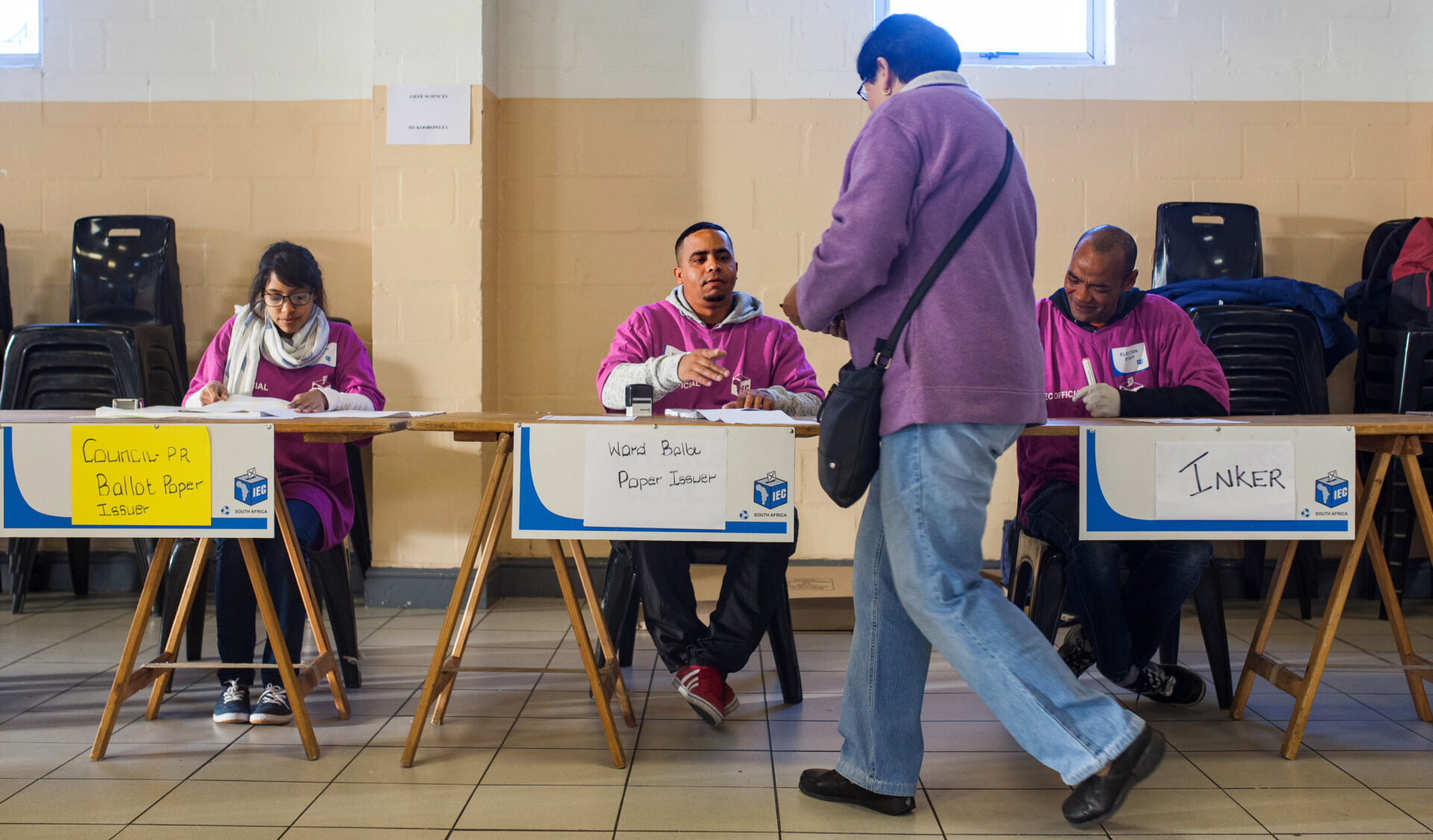
With South Africa’s 2026 Local Government Elections approaching all talk seems to be of the growing prevalence of coalitions in the country. However, the rise in coalition governance is coinciding with another electoral trend: the stalling of progress in women’s representation in legislative bodies. At local government level, improved participation of women is not only essential for ensuring broader social inclusion, but has also been shown to promote better governance, strengthen policy-making, and enhance community resilience. Yet, despite substantial initial progress since 1994 and the introduction of specific policies such as the National Policy Framework for Women’s Empowerment and Gender Equality, the country has struggled to consistently elect women to more than 40% of council seats in recent election cycles. Bearing these two trends in mind, it is necessary to ask what impact coalition politics has had on woman, both in elected government positions and in the broader society.
Outside of coalition politics, women in elected positions or involved in politics already, face a number of challenges to participation. For example, the United Nations (UN) has noted that nearly 60% of women parliamentarians and over 70% of women journalists have experienced sexist abuse online. More worryingly, up to 44% of women in some countries have reported that such online abuse subsequently escalated into offline harassment or violence. More generally, a global study by The Economist found that nearly 40% of woman reported had experienced online abuse, while 85% of women had witnessed digital violence against other women. Online abuse is only one example of the plethora of gender-specific challenges women face in the public sphere, with others including, inter alia, institutional chauvinism, exclusion, epistemic injustice, as well as threats and acts of violence. Equal representation of woman in politics is important not only because it promotes democratic legitimacy, but because it helps to bring these challenges to the fore. Women’s representation is a key factor in the mainstreaming of women’s experiences and thus more gender equality focused policies and practices.
Women’s representation is a key factor in the mainstreaming of women’s experiences and thus more gender equality focused policies and practices
Tweet
Despite the challenges outlined above, women’s representation in South African local government had seen significant progress since the first democratic local government elections in 2000. Initially, women councillors accounted for 29% of seats. This number increased to 40% in 2006 but dipped to 38% in 2011. Representation improved again in 2016, rising to 41%, but dropped to 36.9% in the 2021 local government elections. However, there is no legislation compelling these, or any other gender-balancing system and so the proportion of men and women on party lists remains at the discretion of political parties. This has historically translated to fewer women in municipal councils, with women’s representation in proportional representation (PR) seats dropping from 48% in 2016 to 24.2% in 2021, and the percentage of ward seats held by women falling from 33% in 2016 to 12.7% in 2021. It should be noted that this decline in no way reflects women’s level of political participation. Women in South Africa have consistently made up the majority of registered voters since 1994.
This drop in gender representation between 2016 and 2021 coincided with a more than doubling in the number of local coalition governments, giving rise to at least a prima facie case that the two developments are related. Historically, the African National Congress, which dominated South African politics, and the Economic Freedom Fighters, made use of internally enforced gender quota systems, including ‘zebra lists’ for candidate selection, which means that their party lists alternate between one man and one woman. However, South Africa has no legislation requiring political parties to adopt gender quotas or other gender-balancing mechanisms. Some parties, such as the Democratic Alliance and Action SA explicitly reject such systems, preferring what they describe as a ‘merit-based’ approach. While some newer parties, such as Rise Mzansi, have adopted gender quota systems of their own, the dispersal of votes between more parties, the same phenomenon that necessitates the formation of more coalitions, has led to a decline in women councillors.
Digging a bit deeper, however, it seems likely that coalition politics itself may reinforce old barriers to gender representation. Mokgadi Mogane of the Commission for Gender Equality has cautioned that gender parity is often an early victim of coalition negotiations. The problem here is not just that there is a lack of women’s representation in elected offices, but also that in many instances, women are not empowered to shape outcomes. An equitable representation in parties and councils does not guarantee representation in senior decision-making positions. There have been many calls to improve the support provided to women councillors, recognising that there are barriers, such as those discussed above, which function to suppress both women’s participation and the efficacy of their participation. Moreover, it is important to remember that women are not a homogeneous group, and many support political parties that do not prioritise gender equality in their platforms. As a result, women are not always represented in coalition negotiations, and even when they are, gender equality may still appear an easy bargaining chip to trade away.
The problem here is not just that there is a lack of women’s representation in elected offices, but also that in many instances, women are not empowered to shape outcomes
Tweet
Solving these problems may require a multi-faceted approach. The Local Government: Municipal Structures Amendment Bill, or ‘Coalition Bill’, first gazetted in 2024, so far does not include any gender parity provisions, and it may be difficult to legislate for equal gender representation directly when many parties explicitly reject such policies. While this should still be attempted, it should be supplemented by other endeavours. On a societal level there is a need for broad education programmes that emphasise gender equality and combat the sexist myths that underlie gender-based violence. There is also a need to introduce new capacity-building programmes and to strengthen existing ones for women and young people seeking to participate directly in politics. Such programmes can help to ensure that, if elected, they have the skills and understanding to make an impact. Finally, there is a need for greater support for women councillors and government officials based on their specific needs. These could include measures such as childcare provision, special systems for reporting discrimination, harassment and abuse and fora for sharing experiences, building professional networks and providing peer support.
Adam Randera is an independent peacebuilder and researcher who specialises in transitional justice, youth- and gender- inclusivity and coalition governance
