
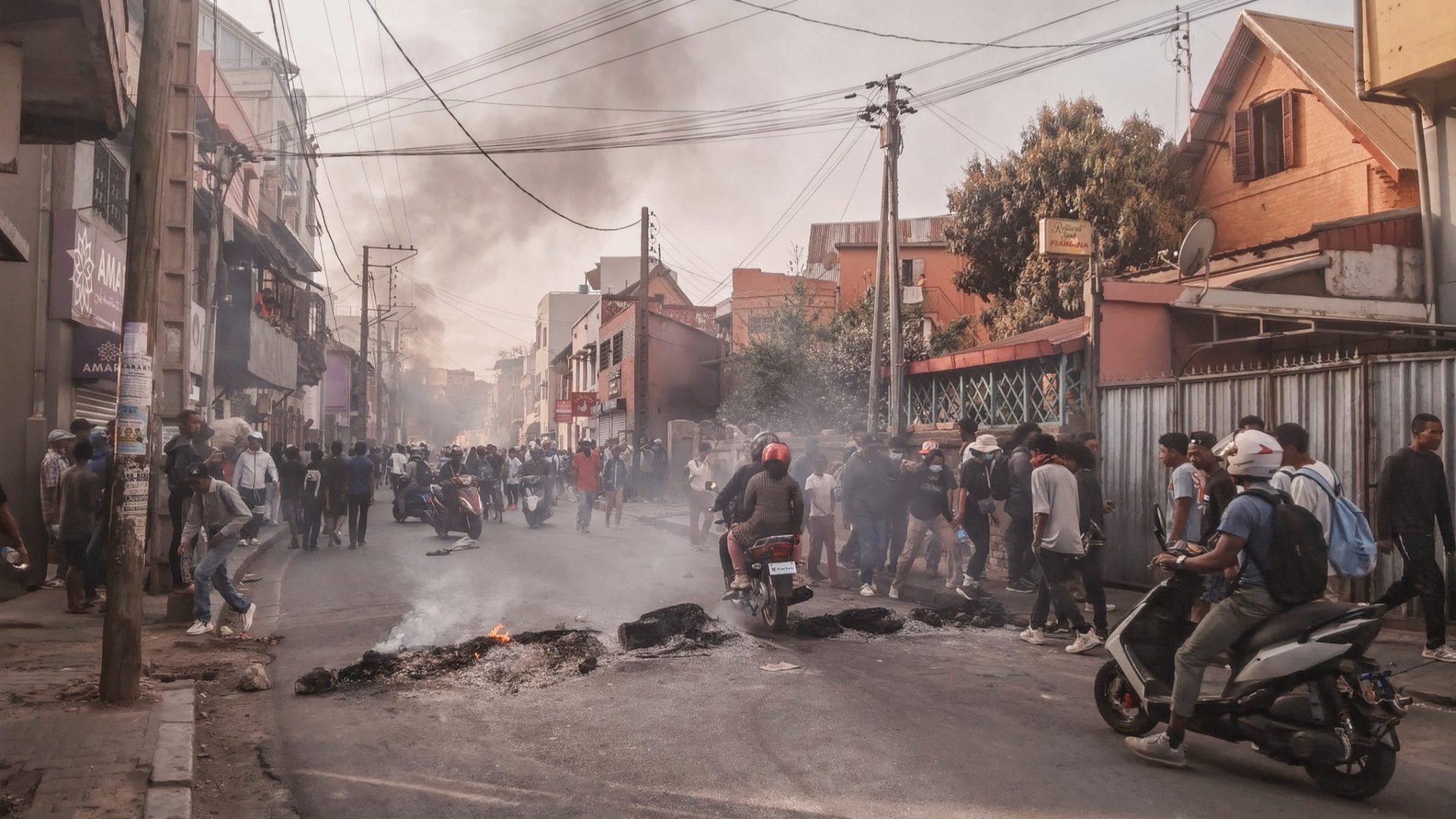
Madagascar’s currently unfolding political crisis, which has seen President Andry Rajoelina flee the country and the military declare transitional rule under Colonel Michael Randrianirina, is not an aberration. It is the latest episode in a long experiment with authority, leadership legitimacy, and the fragile architecture of democracy. The events of October 2025 mark not only the collapse of an incumbent presidency but also the failure of Madagascar’s post-2009 political compact and transition. In my as yet unpublished Master’s dissertation, Coup Leaders as Emergent Leaders, I anticipated precisely this scenario: when leaders derive their power from an unconstitutional change of government (UCG), they inherit a permanent legitimacy deficit that no election, decree, or international endorsement can ever fully erase.
Legitimacy and the unfinished coup
Rajoelina’s first seizure of power in 2009 was a foundational moment that redefined the Malagasy state. It was an instance of leadership emergence in the political vacuum induced by an unconstitutional change of government. Rajoelina’s High Transitional Authority (HAT) became the template for a form of governance that mixed populist rhetoric, military support, and international ambivalence.
The situation in Madagascar in 2009, can in part be viewed through the framework of leadership legitimacy from above and below, thus capturing an essential fault line, between de jure legitimacy, referring to legal recognition, and de facto legitimacy reflecting popular acceptance and moral credibility. Rajoelina managed to sustain the former but progressively lost the latter. His government’s inability to deliver tangible development, manage corruption, or maintain trust with the military, gradually hollowed out the social contract that kept him in power. Thus, Rajoelina’s initial success stemmed from the perception that he embodied emergent leadership as an energetic outsider rising against an ossified elite, in former President Marc Ravalomanana. Gradually, however, the social capital that underpinned his legitimacy dissipated. During his 2009–2013 administration, Rajoelina rallied citizen support by capitalising on declining transparency, accountability, and socio-economic performance under the Ravalomanana regime. That same pattern has re-emerged in Madagascar over the past two years. By 2025, the government’s authority was visibly transactional. Economic inequality has persisted, youth unemployment has soared, and service delivery, particularly the provision of energy and water, came to symbolise Madagascar’s dysfunction. These grievances provided fertile ground for the new generation of protesters, dubbed “Gen Z Mada,” whose mobilisation echoed what I term the contestation of leadership legitimacy from below. When the government ordered the army to disperse crowds, sections of the security forces defected instead, showing that military relations often act as the hinge upon which post-coup leadership rises or collapses.
Cycle of unconstitutionalism
Rajoelina’s downfall unfolded with grim symmetry. Parliament impeached him for abuse of office, while the elite CAPSAT unit, once the guarantor of his 2009 ascendancy, declared allegiance to the protesters. The military’s subsequent suspension of the constitution and installation of Colonel Randrianirina as interim president illustrates what can be described as the cyclical nature of unconstitutional change, in that, once a state accepts the seizure of power outside constitutional norms, that method of transition becomes a recurring instrument of politics. In this sense, the new military leadership is not breaking with the past but reproducing it. The 2025 “interim authority” mirrors the HAT of 2009 in that an unelected caretaker is being justified as a path to eventual democracy. The writing is on the wall with each iteration of extra-constitutional governance in Madagascar further eroding institutional trust, rendering the next rupture easier to justify. The military’s promise to restore stability within two years therefore sits uneasily against the historical record. Almost every Malagasy transition since independence has begun with similar pledges and ended with renewed disillusionment.
The 2025 “interim authority” mirrors the HAT of 2009 in that an unelected caretaker is being justified as a path to eventual democracy. The writing is on the wall with each iteration of extra-constitutional governance in Madagascar further eroding institutional trust, rendering the next rupture easier to justify
Tweet
The international dimension and the reassertion of “power from below”
The concept of international legitimation, whereby external factors, such as the Southern African Development Community (SADC), African Union (AU), and European Union (EU), wield dual influence – punitive and constructive – in shaping the post-coup order is relevant to Madagascar. The same pattern is now unfolding again. Early reactions from the AU and United Nations condemn the military’s intervention, with the AU suspending Madagascar from all activities, yet calls for mediation have already begun. SADC, which once midwifed the 2013 Roadmap for Ending the Crisis, faces pressure to reprise its role as regional guarantor. Analysis warns that this oscillation between censure and accommodation reinforces legitimacy from above: a government may lose domestic support yet retain international recognition if it promises eventual elections. The paradox is that the very actors seeking to restore democracy often entrench leaders or regimes whose authority originates in its suspension. Despite the institutional breakdown, the mass mobilisation that precipitated Rajoelina’s flight represents a genuine shift in the Malagasy political imagination. Multiple theories of leadership emergence argue generally that new leaders arise not merely from formal structures but through the collective redefinition of what is acceptable power. In 2009, that redefinition favoured a youthful mayor challenging an aging establishment. In 2025, it favours citizens, mostly youth, reclaiming agency from what they believe is a detached ruling class. The political energy of Madagascar’s youth may yet form the basis for a different kind of legitimacy, one that is grounded in civic rather than military authority, if it can avoid being co-opted by new elites.
What Rajoelina’s fall reveals about leadership in fragile democracies
Northouse’s leadership-as-process model, with African leadership realities, offers a lens for understanding the present moment. Leadership, he argues, is neither inherent nor permanent but a continuous process of legitimation, negotiated through power, performance, and perception. Rajoelina’s career demonstrates the dangers of confusing power with legitimacy. His authority was maintained by coercive and positional bases of power, what the authors, French and Raven called “reward” and “legitimate position” power, but it lacked the moral and referent bases that generate durable consent. Rajoelina’s downfall illustrates how, in fragile democracies, legitimacy cannot be hoarded. It must be renewed through responsiveness and inclusion, because once coercion replaces consent, the leader’s fall becomes only a matter of sequence.
Rajoelina’s downfall illustrates how, in fragile democracies, legitimacy cannot be hoarded. It must be renewed through responsiveness and inclusion, because once coercion replaces consent, the leader’s fall becomes only a matter of sequence.
Tweet
Madagascar’s crisis does not only represent the removal of one man. It is the exposure of a structural void in their process of democratisation. Rajoelina’s journey from coup leader to elected president to exiled fugitive completes the arc my research outlined two years ago, in that leadership born of illegitimacy must constantly perform legitimacy to survive. Rajoelina’s failure to sustain that performance, both at home and abroad, has restored the island to the terrain of interim juntas and suspended constitutions. The challenge ahead is to build what in leadership theory is termed “thick mutuality between state and society,” that is the moral infrastructure of legitimate leadership. Without it, every transition will remain provisional, every claim to legitimacy unsettled, and every promise of democracy another step in an unfinished coup.
Keenan Govender is a Researcher focusing on leadership, governance, peace and security, and a former Peace and Security Fellow at the African Leadership Centre. Keenan holds an MSc in Global Leadership and Peacebuilding from King’s College London.
