
As African leaders gathered in Addis Ababa, Ethiopia for the African Union (AU) Heads of State Summit in February 2026, they did so amid a profound rupture in the global peace and security landscape. The multilateral system that has underpinned peace operations and humanitarian response for decades is under strain. The United Nations (UN) as a whole is facing deep contraction; mass restructuring is taking place amid serious financial challenges. The political legitimacy of the United States and other traditional security guarantors has weakened. Donor priorities are fragmenting as geopolitical competition intensifies and domestic pressures in the Global North grow.
At the same time, Africa is experiencing an escalation of violent conflict and humanitarian crises. Wars are more protracted, more fragmented, and deeply embedded in social, political, and economic systems. From Sudan and the eastern Democratic Republic of the Congo (DRC) to the Sahel and northern Mozambique, civilians are navigating overlapping threats: armed violence, displacement, climate shocks, food insecurity, and shrinking humanitarian access.
This moment calls not only for African leadership, but for alternative ways of thinking about how emergencies are engaged. If, as was repeatedly heard in Addis Ababa, Africa is to take greater ownership of its peace and security future, it must also rethink the tools it relies on, particularly the long-standing separation between emergency response, peace operations and peacebuilding.
The limits of treating peacebuilding as ‘post-crisis’
Peacebuilding has traditionally been framed as something that happens once violence subsides and humanitarian needs stabilise. Emergency response, by contrast, has focused on short-term life-saving assistance and security measures, often prioritising speed and scale over political and social analysis. This linear framing has shaped how crisis responses are designed, funded, and managed – despite growing evidence that it does not reflect how conflict is actually experienced.
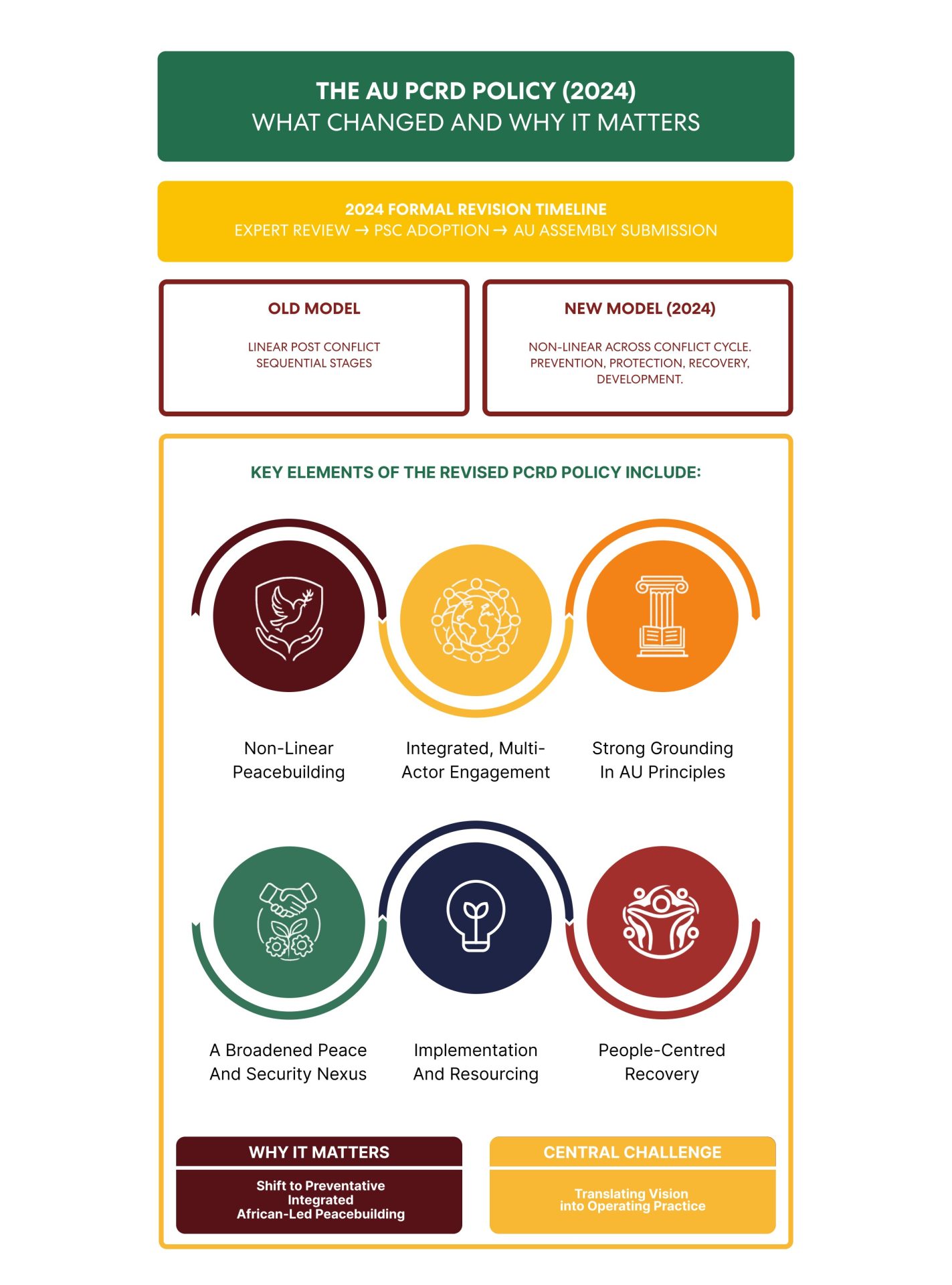
In today’s conflicts, crisis is no longer a phase; it is a condition. Civilians are not waiting for peace to begin protecting themselves, mediating disputes, or engaging armed actors. They are already doing so, often in the absence of effective state protection or sustained international presence. This reality is increasingly recognised at policy level. The AU’s revised Post-Conflict Reconstruction and Development (PCRD) Policy, revised in 2024, explicitly acknowledges that peacebuilding is non-linear and that prevention, protection, stabilisation, and recovery frequently unfold simultaneously, including during active conflict.
However, a gap persists between this conceptual shift and operational practice. The result is a growing mismatch between how crises are experienced on the ground and how they are formally responded to. Emergency interventions that neglect conflict dynamics, power relations, and civilian agency can unintentionally reinforce violence, by exacerbating competition over aid, legitimising abusive armed actors, or sidelining community mechanisms that reduce harm. Despite the PCRD policy’s broader vision, institutional silos, security-first approaches, and segmented funding streams continue to limit the integration of peacebuilding into emergency engagement.
It is within this gap that unarmed, civilian-led methodologies, such as Unarmed Civilian Protection (UCP), offers a practical bridge between emergency response and peacebuilding. By working with civilians as protective and political actors – through protective presence, early warning and early response, mediation, and dialogue with armed actors – UCP operationalises the PCRD’s non-linear vision in real time. It enables peacebuilding to begin during crises, not after them, in that way it expands the AU’s emergency toolkit with locally led, preventive approaches that reduce violence while laying foundations for longer-term peace.
Unarmed civilian protection: bridging peacebuilding and emergency response
UCP offers a critical tool for bridging the gap between emergency response and peacebuilding. It enables local actors to pursue peacebuilding even amid acute insecurity through protective presence, relationship-building, and inclusive engagement. Grounded in nonviolence and local leadership, UCP works alongside communities to reduce violence, build trust, and support nonviolent solutions.
UCP practices – such as protective presence, accompaniment, early warning and early response, community-based protection planning, and dialogue with armed actors – operate predominantly in emergency settings. These approaches are designed to prevent harm, reduce threats, and support civilian agency in real time. Crucially, they recognise and engage directly with conflict dynamics rather than bypassing them.
At the heart of UCP is a fundamentally different understanding of civilians. Instead of framing them solely as victims or passive recipients of aid, UCP recognises civilians as political and protective actors capable of influencing their own safety and the behaviour of armed actors. This challenges dominant emergency paradigms that prioritise external intervention and short-term stabilisation while overlooking community-led protection strategies.
At the heart of UCP is a fundamentally different understanding of civilians. Instead of framing them solely as victims or passive recipients of aid, UCP recognises civilians as political and protective actors capable of influencing their own safety and the behaviour of armed actors.
Tweet
UCP and peacebuilding are grounded in shared principles: a commitment to nonviolence, local ownership and leadership, and strong conflict sensitivity guided by the principle of ‘do no harm’. Both recognise that durable peace and effective protection cannot be externally imposed, but must be built from within communities. UCP’s emphasis on trust and long-term relationships strengthens the legitimacy and sustainability of peacebuilding processes.
Importantly, UCP represents a shift in how protection itself is understood. It challenges the assumption that safety requires armed force, instead centring relational security, community presence, and local agency. While UCP is often viewed as short-term and peacebuilding as slow and structural, this binary obscures UCP’s immediate impact. In practice, UCP enhances civilian safety, enables participation, and creates the conditions for longer-term peacebuilding to take root.
When grounded in inclusive leadership – particularly by women and youth – UCP transforms immediate protective presence into lasting structural impact. Early warning and unarmed protection build the security and social cohesion required for local peacebuilding to flourish. By embedding protection within local relationships and institutions, UCP enables communities not only to survive crisis, but to use moments of disruption to reimagine safety, equity, and coexistence – demonstrating that peacebuilding can and must happen within emergencies.
Implications for the African Union
The AU has developed increasingly strong normative frameworks on conflict prevention, protection of civilians, and sustaining peace. Yet in practice, emergency responses remain heavily skewed toward militarised and short-term stabilisation approaches whereby civilians are engaged on an ad-hoc basis.
Reframing civilian-led peacebuilding and preventative approaches as emergency engagement requires a practical shift in how responses to crises are designed, financed, and implemented across the AU Peace and Security Architecture:
- Adapt financing and planning frameworks to enable peacebuilding and PCRD interventions to operate during active conflict and acute emergencies, rather than confining them to post-crisis phases. This includes greater flexibility to support prevention, civilian protection, and community-led action in high-risk settings.
- Rebalance peace support operations by elevating civilian expertise, community engagement, and nonviolent protection approaches alongside military and police components, in line with the AU’s people-centred and prevention-oriented commitments.
- Prioritise sustained political engagement with civilians and local actors as a core element of crisis response, recognising communities not as beneficiaries but as partners in protection, prevention, and peacebuilding from the earliest stages of intervention.
Reframing civilian-led peacebuilding and preventative approaches as emergency engagement requires a practical shift in how responses to crises are designed, financed, and implemented across the AU Peace and Security Architecture
Tweet
In a context of shrinking global resources and declining external legitimacy, investing in civilian-led, preventive approaches is not only normatively sound – it is strategically necessary.
Lesley Connolly is the Regional Policy and Advocacy Manager at Nonviolent Peaceforce.
