
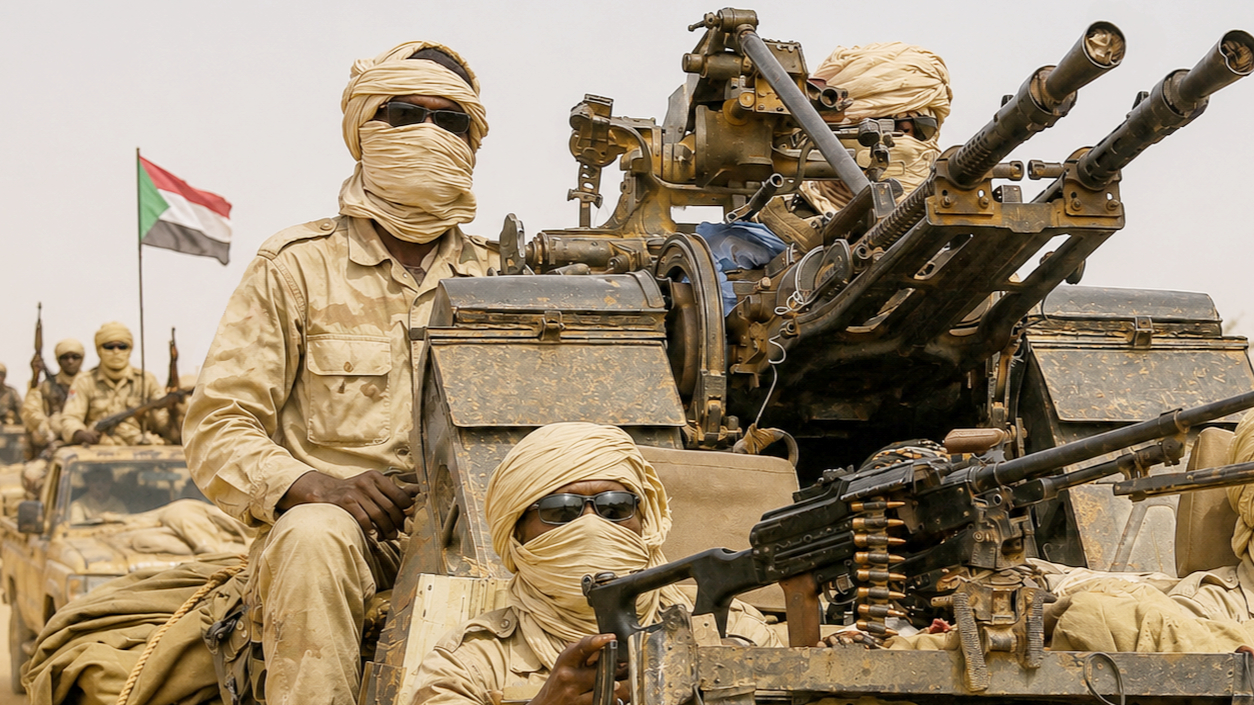
On 15 April 2023, Sudan’s Armed Forces (SAF) and the Rapid Support Forces (RSF) erupted into full-scale civil war, triggering one of the world’s gravest humanitarian catastrophes with over 10 million people displaced and mass atrocities documented in Darfur. What distinguishes this conflict is not only its ferocity, but its technology: Sudan has become a live laboratory for autonomous drone warfare, artificial intelligence (AI)-assisted surveillance and open-source intelligence (OSINT) deployed in real time by belligerents and civil society monitors alike.
This paper interrogates a central paradox: the same AI technologies that could save lives through early conflict detection are being weaponised to destroy them. As drones, satellite AI analysis and social media monitoring proliferate across African conflict zones, the African Union’s (AU’s) peace architecture, conceived before the AI era, remains dangerously under-equipped to govern them.
| 1,003+Drone strikes Apr 2023–Jan 2026 (ACLED) | 2,200+Civilian deaths from drone attacks | 80%Of drone deaths in 2025 alone | 10M+People displaced |
Drones, AI and the new dynamics of African warfare
Both the SAF and RSF have deployed an array of commercially sourced unmanned aerial vehicle (UAVs), from the Turkish-made Bayraktar TB2 to China’s Wing Loong II and FH-95, with ACLED recording 1,003 strikes between April 2023 and January 2026. More critically, AI-enabled swarm drone technology has entered the theatre for the first time, enabling coordinated autonomous strikes with minimal human oversight. The December 2024 attack on a hospital in Kalogi, which killed more than 114 people, exemplified how algorithmic targeting can produce mass casualties at a speed that accountability mechanisms cannot match.
Foreign involvement deepens governance challenges. Iran, Russia and the United Arab Emirates (UAE) have all supplied drone technology in exchange for strategic concessions, turning Sudan into a proxy theatre for emerging technology warfare. Any African regulatory response must therefore engage international supply chains, not merely domestic deployments.
The dual-use dilemma: AI as protector and predator
The same technologies enabling atrocities are simultaneously deployed with constructive intent. UNOSAT has used AI-assisted satellite imagery to document destruction in Khartoum and Darfur in near real-time. Civil society OSINT projects have tracked over 1,700 civilian casualties through AI-assisted analysis, evidence now before the United Nations (UN) Panel of Experts. The AU Peace and Security Council (PSC) acknowledged in June 2024 that AI tools for hate speech detection, displacement prediction and conflict pattern analysis are urgently needed in its early warning toolkit, yet the Continental Early Warning System (CEWS) was entirely designed before machine learning existed at operational scale.
The AU’s response: progress and gaps
The AU has begun to respond. Its historic 1214th PSC session (June 2024), the first dedicated to AI and peace and security, acknowledged a dangerous ‘regulatory vacuum’. A follow-up ministerial session in March 2025 called for a Common African Position on AI. A November 2025 technical workshop in Kigali produced a joint AU-Regional Economic Communities/Mechanisms (RECs/RMs) Roadmap to integrate AI into CEWS, and the AU AI Advisory Group on Governance, Peace and Security convened in Nairobi in December 2025.
Yet critical gaps persist. No binding continental instrument governs autonomous surveillance technologies or lethal autonomous weapons systems (LAWS). The Kigali roadmap lacks enforcement mechanisms, liability frameworks or civilian protection safeguards. Most CEWS regional nodes lack the technical capacity to operationalise AI tools, and the question of digital sovereignty – who controls African conflict data – remains unresolved.
Recommendations
Tier 1: Prohibition: An African Charter on Autonomous Weapons should prohibit fully autonomous lethal systems that select targets without meaningful human control. The Sudan precedent, in which algorithmic targeting killed civilians in hospitals and schools, provides clear moral and legal grounding.
Tier 2: Regulation: A continental licensing regime should govern the import and deployment of dual-use AI surveillance technologies. It should be enforced through the AU’s Committee of Intelligence and Security Services of Africa (CISSA) and an AI-equipped CEWS Situation Room in Addis Ababa, with mandatory interoperability across the Intergovernmental Auhtority on Development (IGAD), Economic Community of West African States (ECOWAS) and Southern African Development Community (SADC) nodes.
Tier 3: Empowerment: An African AI for Peace fund should finance beneficial AI tools for conflict detection and atrocity documentation, with formal institutional recognition for civil society OSINT actors and data-sharing agreements with AU bodies.
An African Charter on Autonomous Weapons should prohibit fully autonomous lethal systems that select targets without meaningful human control
Tweet
Conclusion
The Sudan crisis has exposed one of the most consequential governance failures of our era: the absence of a continental framework to regulate AI-powered surveillance and autonomous weapons in African conflict zones. The AU’s recent diplomatic steps signal growing political will, but that will must become binding law, institutional capacity and adequately funded implementation. The continent paying the highest price for ungoverned technology must now lead the world in governing it. Sudan demands not only documentation, but a response in law, in institutional architecture and in political courage.
The Sudan crisis has exposed one of the most consequential governance failures of our era: the absence of a continental framework to regulate AI-powered surveillance and autonomous weapons in African conflict zones
Tweet
Abraham Ename Minko is a Senior Researcher and Policy Analyst in Peace, Security, and Conflict Resolution.
