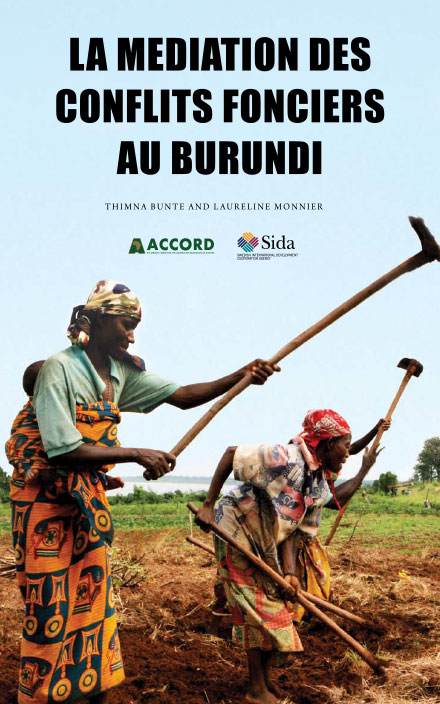
Mediating Land Conflict in Burundi (French)
ACCORD has been active in Burundi since 1995, playing a second-track diplomacy role in the Arusha peace negotiations that led to the Arusha Peace and Reconciliation Agreement for Burundi in

ACCORD has been active in Burundi since 1995, playing a second-track diplomacy role in the Arusha peace negotiations that led to the Arusha Peace and Reconciliation Agreement for Burundi in
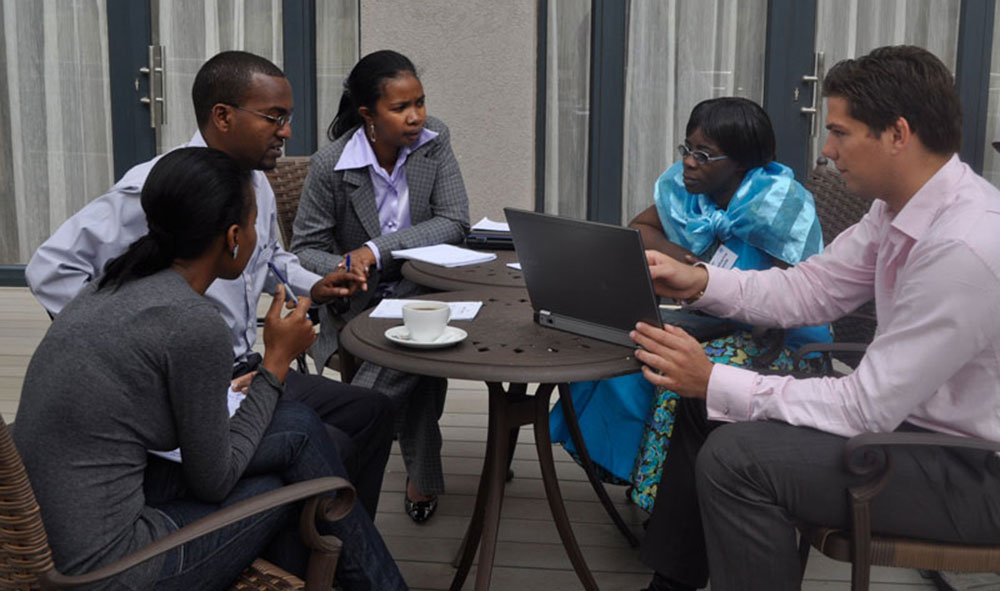
On 19 and 20 August 2011, the Global Partnership for the Prevention of Armed Conflict (GPPAC) Southern Africa Regional Steering Committee Workshop met in Durban, South Africa, to discuss developments
According to the author, the thrust of this book is to explore the question ‘whether African militaries can ever accept civilian control’ (p. vi). The fact that he phrases the essence
Abstract This paper interrogates and rejects the effectiveness of consensus building as a mechanism for conflict resolution in Africa. Drawing from the conflict/consensus theoretical debates of the 1960s, the paper
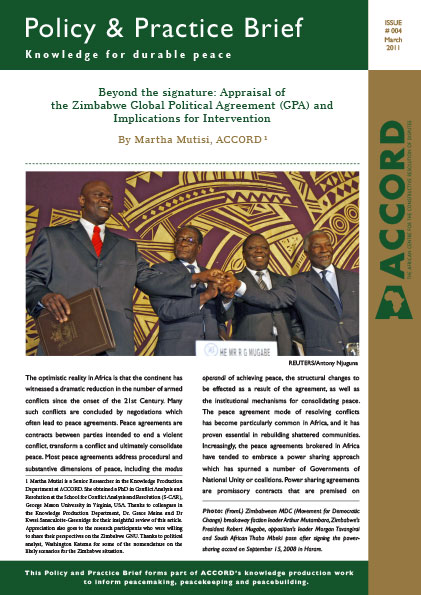
The optimistic reality in Africa is that the continent has witnessed a dramatic reduction in the number of armed conflicts since the onset of the 21st Century. Many such conflicts
Since the establishment of the United Nations Mission in Sudan (UNMIS) in 2005, the Civil Affairs Division (CAD) has gained considerable field experience with local-level conflict management in the complex
The African Standby Force (ASF) is an important tool of the African Peace and Security Architecture for the prevention, management and resolution of conflicts on our continent. An appreciable amount
The African Standby Force (ASF) is an important tool of the African Peace and Security Architecture for the prevention, management and resolution of conflicts on our continent. An appreciable amount
The Civilian Dimension Policy Framework clarifies the policy context, the multidimensional management structure and decision-making process, the main civilian roles and responsibilities, the mission support functions as well as the