
As with most political projects, the collapse of democratic transitions is rarely tied to a single event. It is better explained through a series of political decisions and developments modulated by structural factors, whose cumulative effects call for an autopsy of the transition itself. Ethiopia’s case reflects this trajectory. The significance of the 2026 election in this trajectory lies not in the political event itself, but in what it reveals: a data point in a long-standing pattern of failure and the entrenched political culture that pattern has created.
The 2018 political opening revived the promise of democratic transition, a promise that originally emerged in the early 1990s before giving way to an autocratic political project in the post-2005 period. Although the 2018 transition led to significant political realignments, it largely unfolded within the same monolithic party-state that ran the post-2005 elections in which it captured nearly 100% of legislative seats. The government, once forced to promise democracy by a sustained mass protest, eventually shed these constraints amid the crackdowns and wars that followed the postponement of the 2020 election.
By the time the 2021 election cycle took place, most viable opposition actors had already been weakened through arrests, harassment, office closures, legal restrictions and, in some cases, constituency-targeted violence. Consequently, much like the post-2005 era, elections have continued with ceremony and pomp, but genuine electoral uncertainty, popular choice and the prospect of a peaceful change in government have now largely disappeared. Throughout the cycles of democratic transition and regression, the central failure lay not merely in the conduct of elections, but the enduring inability to establish a political order in which political opposition was not a lethal endeavour and losing power was survivable.
Elections without vital signs of democracy
In the 2026 election, the Prosperity Party won 438 of the 486 House seats for which results had been officially declared. The remaining forty-eight seats went to sixteen other parties and eight independent candidates. Almost all of these victories came in constituencies the ruling party had chosen not to contest, with several successful candidates having ties to Prosperity Party structures. While the incumbent portrayed its decision not to compete in some constituencies as a commitment to a new kind of openness to opposition competition and a more diverse parliament, the arrangement amounted to managed pluralism rather than genuine electoral competition. Besides the novelty of the narrative, neither peaceful alternation of power nor the emergence of a credible alternative was a realistic possibility.
The 2026 election also saw the continued rollback of many reforms that came with the 2018 transition. The legal and institutional reforms introduced across civil society, media, electoral administration and human rights oversight were gradually attenuated. Democratic institutions reconstituted after 2018 underwent extensive leadership reshuffles and structural changes, while civic and political restrictions that had once appeared episodic became more routine. The election was therefore conducted under fragile accountability frameworks, with key institutions, including election management bodies, repeatedly facing questions about their independence as neutral arbiters. This had direct implications for the credibility of the election itself. These institutional weaknesses were compounded by armed conflict, insecurity and widespread displacement, which prevented voting in several regions of the country.
The election’s failures hold, regardless of how democracy is defined or measured. Viewed through a more comprehensive measure such as V-Dem’s Electoral Democracy Index, Ethiopia’s trajectory remains consistent with its classification as an electoral autocracy. This characterisation aligns with the Economist Intelligence Unit’s Democracy Index 2024 and Freedom House’s Freedom in the World 2026 report, which classify Ethiopia as an ‘authoritarian regime’ and ‘Not Free’ respectively. Crucially, even under a strictly minimalist yardstick like the Vanhanen Index, the conclusion does not change. No semantic rescue, nor the shading of the older political identity, has broken the trajectories set more than 30 years ago.
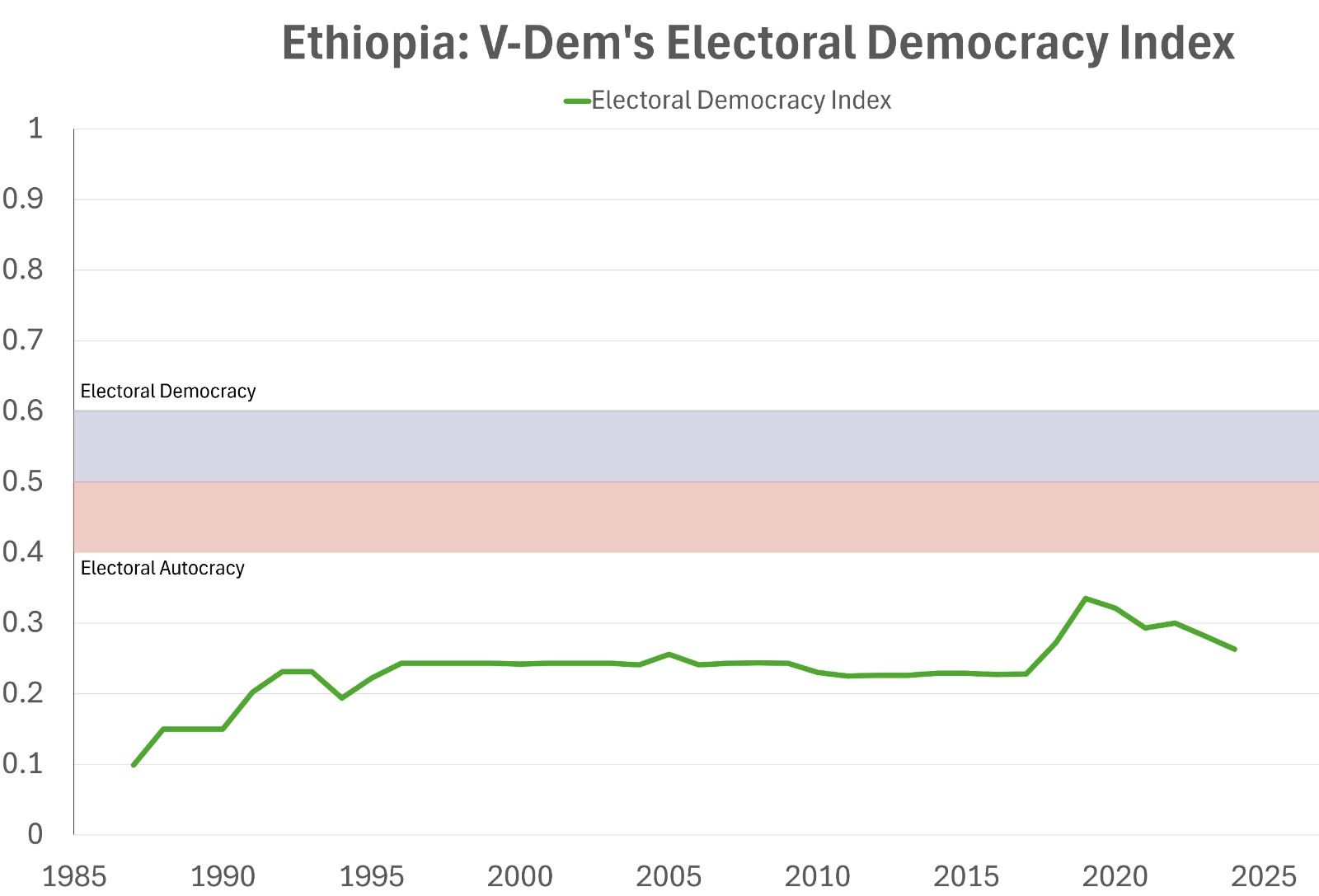
Scores on V-Dem’s Electoral Democracy Index (EDI), based on the 2025 Country–Date dataset. The shaded bands are author-defined reference ranges illustrating a ‘grey zone’ between democracy and autocracy; a range Ethiopia’s trajectory has consistently failed to enter.
The future: from rigor mortis to decay, or another resurrection?
Ethiopia has conducted multiple national elections across periods of reform and regression, first under the Ethiopian People’s Revolutionary Democratic Front (EPRDF) and then under the Prosperity Party. Rather than ushering in a democratic transition, these cycles were repeatedly used by the party-state to claim procedural legitimacy and entrench dominant-party rule. With the ballot box no longer functioning as a safe or credible space for political claim-making, politics moved largely to the streets during the last years of the EPRDF. It has since hardened into insurgencies, militias, armed networks and increasingly militarised local politics.
The Prosperity Party’s conduct gives little reason to believe that it intends to risk ceding power electorally or to pursue a negotiated settlement with its unarmed or armed opponents. Although incumbents carry the greatest share of responsibility for the failure of democratic transitions in Ethiopia, opposition actors also bear significant responsibility for their fragmentation, including through their willingness to strike separate bargains with the ruling party, and for failing to develop professionalised party organisations and programmatic platforms. These shortcomings must be understood alongside a political environment that is often hostile to opposition activity, but they have nonetheless left many parties disconnected from their constituencies and unable to offer a sufficiently credible democratic alternative. The ease with which parts of civil society, including organisations working on human rights and democracy, fractured along partisan and identity lines during the Tigray war and other conflicts, and at times failed to maintain a clear distance from violent political projects, also points to deeper societal divisions and the continued elusiveness of a broad-based political settlement.
The Prosperity Party’s conduct gives little reason to believe that it intends to risk ceding power electorally or to pursue a negotiated settlement with its unarmed or armed opponents
Tweet
Ethiopia, opposition actors also bear significant responsibility for their fragmentation, including through their willingness to strike separate bargains with the ruling party, and for failing to develop professionalised party organisations and programmatic platforms
Tweet
Any assessment of the 2026 and future elections must also account for the changing geopolitical environment. Earlier Ethiopian elections took place within a global context that treated democracy promotion as both a normative commitment and a strategic priority. The 1995 election occurred in the immediate post-Cold War liberal moment, when liberal constitutionalism was ascendant and democracy assistance occupied a far more central place in international policy. The 2005 election took place at the height of Western democracy-promotion efforts in Africa. Yet, this did not mean that external engagement consistently supported substantive democratisation. International actors often prioritised technical administration and procedural continuity over the harder political work of building legitimate and independent institutions.Even the crisis-ridden 2021 cycle attracted significant international and regional assistance, although major international observation missions did not ultimately deploy.
The 2026 election environment is different, partly due to the nature of foreign actors in the Horn of Africa, where new influential non-democratic players have arrived with new agendas, and even former partners engage in openly transactional terms shaped by a renewed scramble and competitive bargaining. While governance and electoral assistance continue, external engagement with Ethiopia has increasingly emphasised green diplomacy, economic cooperation and investment, neoliberal reforms and migration management. As established democracies themselves reel under a tide of democratic decline and retreat from supporting democracy abroad, authoritarian governments face fewer external costs for using elections as instruments of political legitimacy.
All of this leaves Ethiopia with a more fundamental question than whether the 2026 election was democratic. The real question is what, now that the absence of a democratic pulse has been confirmed, could produce a resurrection. After more than 30 years of the rise and fall of Ethiopia’s democratic promise, what remains is a historical record. Whether Ethiopia has the political will to confront that record honestly and act on what it reveals, will determine the country’s next chapter.
Abadir M. Ibrahim is the Associate Director of the Human Rights Program at Harvard Law School. Hilina Berhanu Degefa is a feminist researcher and gender and diversity expert.
